
 Claude Partner NetworkOfficial Anthropic partnerHow we work
Your operation already works. We make it run without the retyping.
We sit with your team, map how the work really happens and turn the repetitive parts into AI agents that do the reading, typing, checking and chasing. Your people keep every decision that matters.
The whole method, from first conversation to agents in production.
Five stages. Each one ends with a decision your team makes.
Agents take over the routine work stage by stage. When one process runs well, we start again with the next one on your list.
Choose
Two or three processes worth changing, and why.
Map
How the work really happens, today and with agents.
Validate
A clickable prototype your team corrects before anything is built.
Pilot
One real cycle, side by side with your current process.
Run and adjust
Agents run the routine, people handle the exceptions.
Midsize companies whose back office grows one hire at a time.
Roughly 50 to 1,000 people. Technology is a means, not the business, and the person who feels the pain is the owner, COO or CFO, not the IT team.
- ✓The same data is typed two or three timesOn its way from the field, the inbox or the portal to the books.
- ✓A few people carry the process in their headsAnd every vacation or resignation is a risk.
- ✓Deadlines depend on someone checking line by lineMonth-end close, renewals, customer onboarding, vendor invoices.
- ✓You tried a software tool and it didn't fitYour process is the advantage. It shouldn't have to bend to someone else's boxes.
A growing book of business, a back office growing with it.
An illustrative composite, built from the kind of conversations we have every week.
Maya is COO of a commercial insurance agency: 250 people, a few thousand business clients, five main carriers.
Every new client means the same information typed into the agency system and again into each carrier's quoting site. Renewals are tracked in spreadsheets, and in busy months nobody has time to review what changed. Claims come in by phone, and follow-up depends on someone remembering to call.
Nothing is broken. It just takes too many people, too many hours and too much attention from the two people who know how it all fits together. Here is what working with us looks like for Maya, step by step.
How we choose, map, validate, implement and adjust.
-
01Choose the processes worth changing
We start with a conversation, not a contract.
In about an hour with Maya and her team leads, we list the recurring work that eats the most time and carries the most risk. We look for processes that are frequent, rule-based, spread across several tools and expensive when they go wrong.
New business submissions, renewals and claims intake all qualify. Advising a client on which coverage to buy does not: that is judgment, and it stays with the producer.
What Maya getsA short list of two or three processes to map first, with a clear reason for each choice. -
02Map how the work really happens
We map the work as it's done, not the org chart.
Maya's lead account manager walks us through a real week on her own screen: where submissions come from, which carrier sites she opens, what she checks, who she calls when something is missing.
We stop her often. Why is this step here? Could this number come straight from the system? Is there a rule that forces it to be done this way? Some steps exist for a good reason, like a regulation or a carrier requirement. Others exist because nobody ever questioned them.
What Maya getsA side-by-side map of each process, today and with agents. Every step shows who does it, which systems it touches and which outside parties it depends on. -
03Validate before we build anything
Her team sees the new process before a line of code.
Within days, Maya's team clicks through a prototype built from their own documents and screens: the submission inbox, the quote comparison, the change summary at renewal. This is where they correct us. "That's not how we place umbrella policies." "The producer has to sign off on that."
We also mark, step by step, where a person must stay in charge: an approval, a signature, a judgment call. Those become clear checkpoints in the new flow, not afterthoughts.
What Maya getsA validated process map, a prototype her team recognizes and a specific proposal: what gets automated, what stays human and what it takes. Mapping and validation typically take two to four weeks. -
04Implement on one real cycle, side by side
Nothing gets switched off on day one.
The agents run one real cycle, a week of new submissions for example, in parallel with the current process. At the end of the week, Maya's team compares both results line by line.
Where the agents got it right, the team stops retyping. Where they missed, we see exactly why and fix it. The agents connect to the systems Maya already uses; we don't ask her to replace them.
What Maya getsProof on her own data, not on a demo, before she commits to rolling out. -
05Run, measure and adjust
The team moves from typing to reviewing exceptions.
Once the pilot holds, the agents take over the routine work. Every action an agent takes leaves a trail Maya can audit.
Operations change: a new carrier, a new product line, a new regulation. We review the process with her team on a regular rhythm, see where people still step in and tune the agents so those moments get rarer. Then we move to the next process on the list.
What Maya getsAn agency that grows its book without growing headcount at the same pace, and a team that spends its time on clients and exceptions.
What your team actually sees, before a single agent is built.
These are screens from our process framework, filled with the illustrative insurance-agency example above. On a real engagement, every step points back to the screen or document your team showed us.
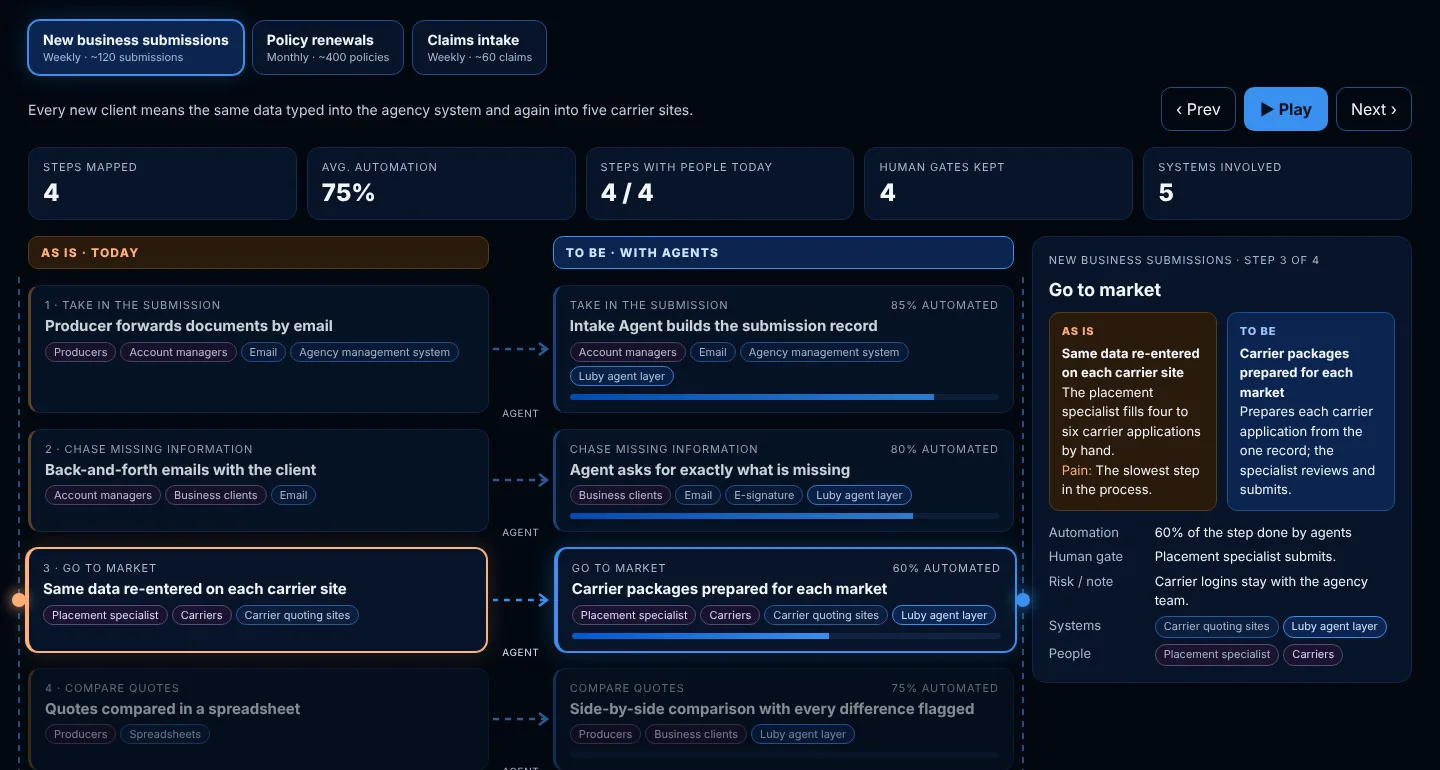
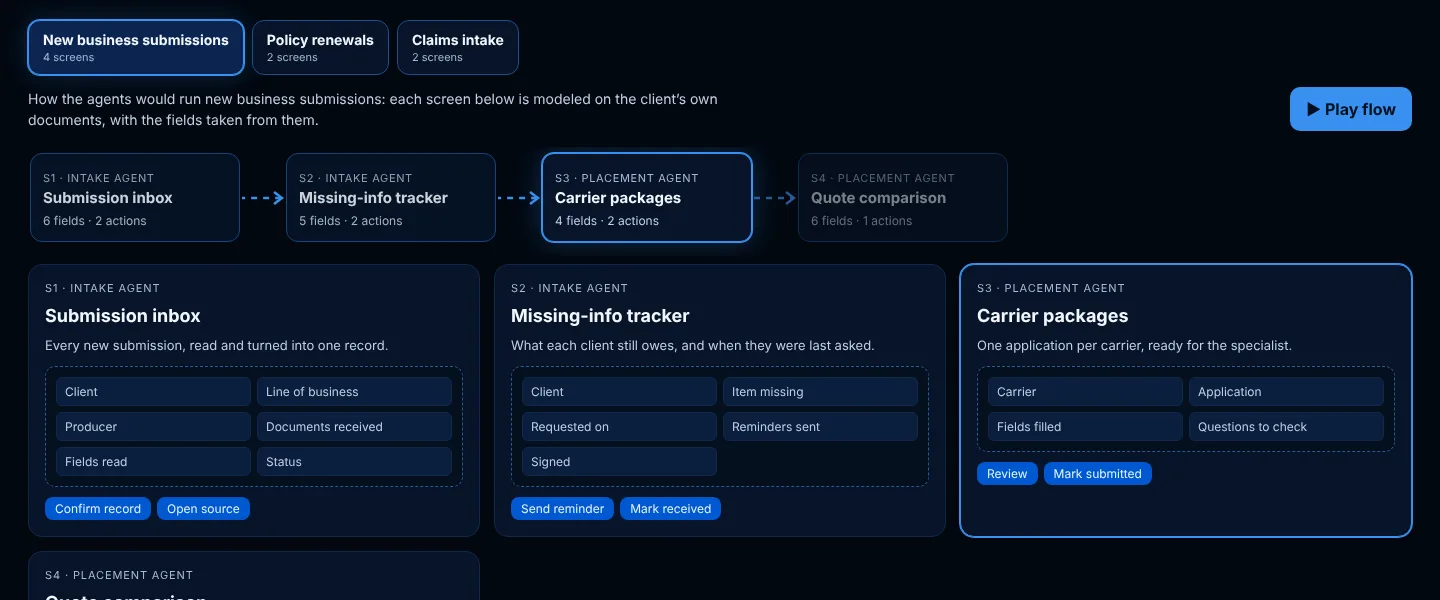
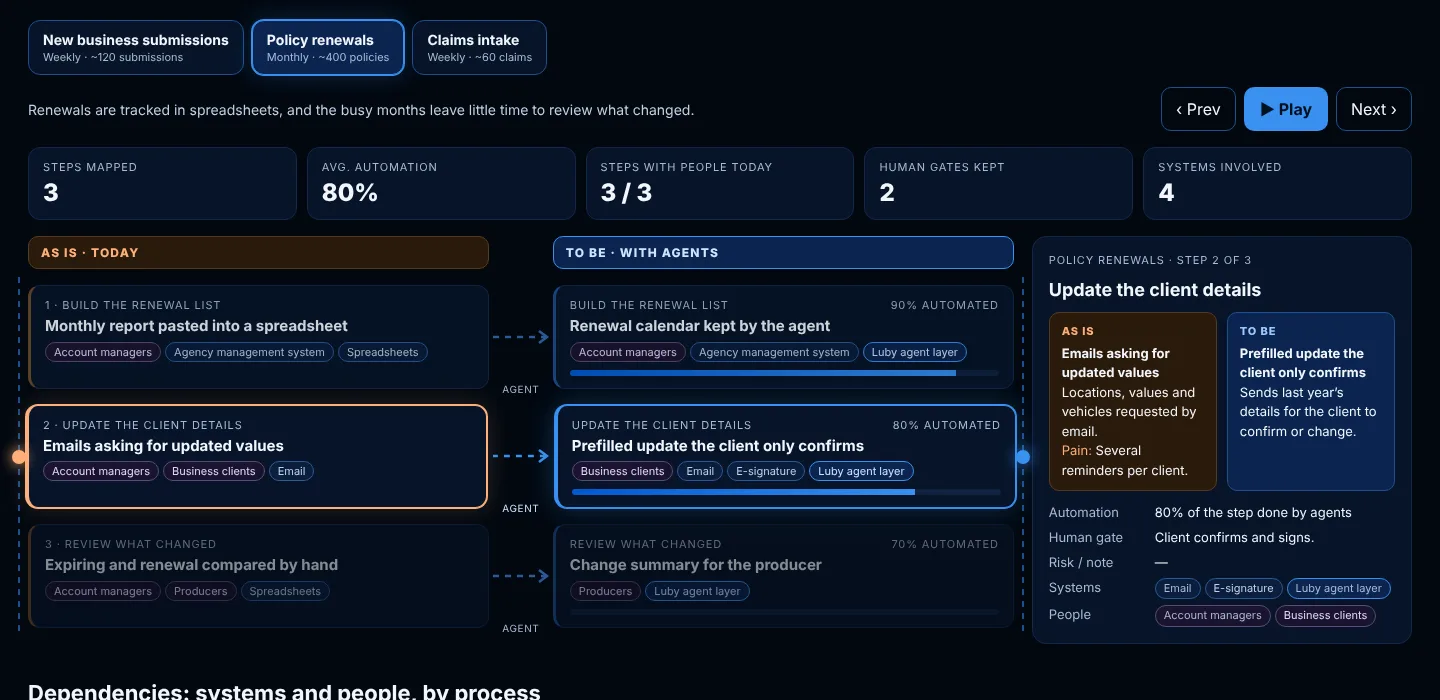
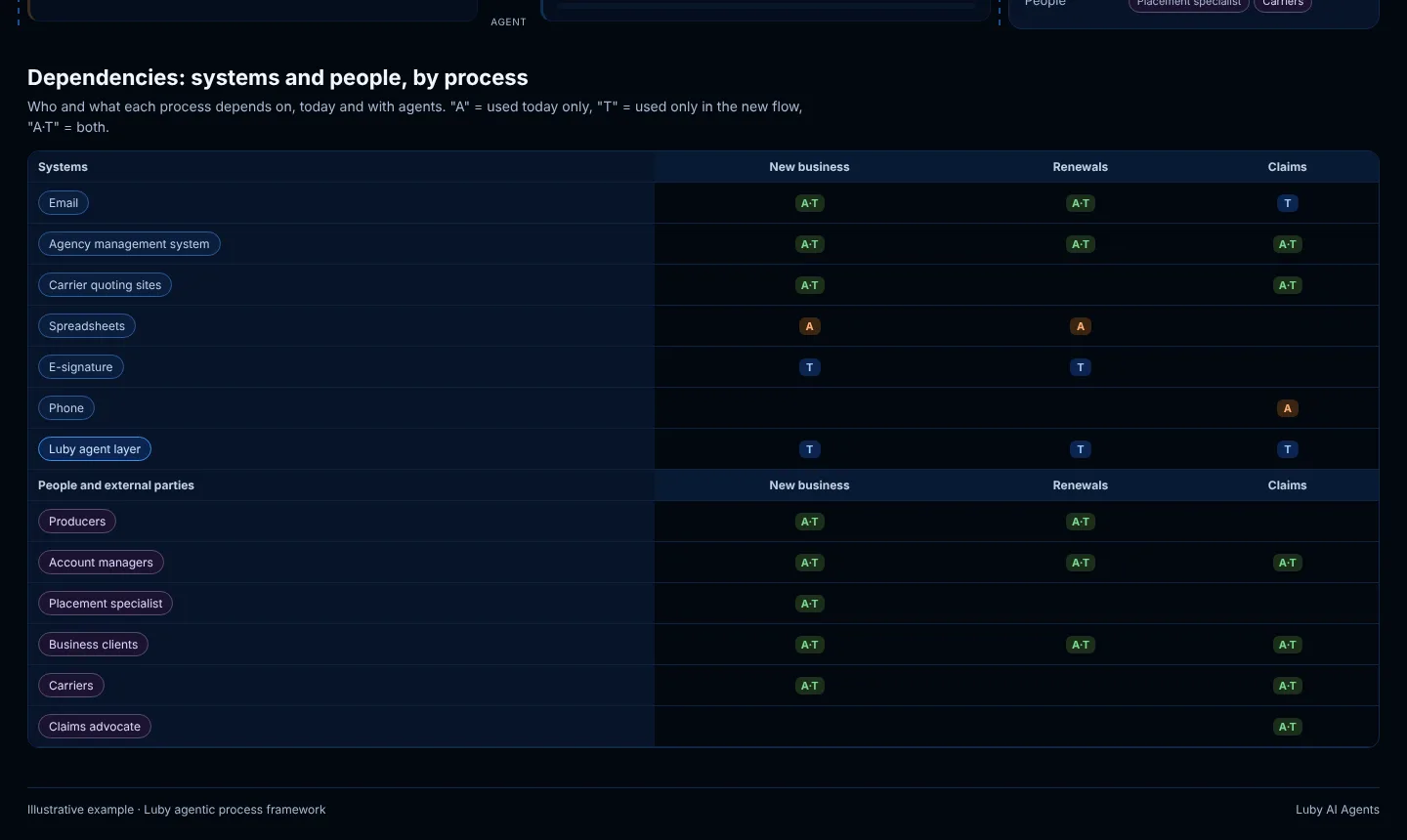
Little of your team's time, and only from the people who do the work.
One person on your side owns the project and makes the calls. A dedicated Luby specialist stays with you from the first conversation to the run phase, so nothing gets lost between selling and building.
Before you pick the first process.
Do we have to replace our systems?
No. The agents work with the tools you already use: your accounting system, your spreadsheets, your email and your portals.
Will this replace my people?
It replaces the retyping and the chasing. Your people keep the approvals, the judgment calls and the relationships, and the team can grow the business without growing at the same pace.
What if a step is regulated?
We map those rules with your team during the mapping stage. Regulated steps keep a named person in charge, with a full record of what the agent prepared. See our governance approach.
How soon will we see something?
Your team sees its own process as a clickable prototype within days of mapping, and proof on real data after the first pilot cycle.
What does it cost?
It depends on the processes you choose. After mapping and validation, you get a specific proposal for your operation, not a generic price list.
23 years of shipping software. Certified for your data.
North American leadership in Miami, senior nearshore engineers whose working day overlaps yours. About Luby →




Which part of your back office takes the most hands today?
In 30 minutes with a senior architect, we'll tell you honestly whether it's a good first candidate, and what the first stage would look like.
- 1A senior architect, not an SDR30 minutes with someone who has shipped agents to production.
- 2An honest first readWhich process to start with, and which ones to leave with people.
- 3No commitmentYou keep the shortlist whether or not you work with Luby.